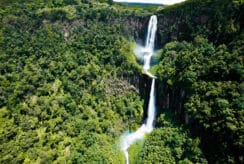
Designated as a UNESCO World Heritage Site and a UNESCO Biosphere Reserve, the Mount Kenya National Park and its surrounding forest reserves function as a vital sanctuary for endemic flora and fauna. While the jagged, alpine peaks of Batian, Nelion, and Lenana attract seasoned mountaineers and technical climbers, the lower montane forests on the southern slopes, harbour pristine, largely untapped environments, among these hidden geographical treasures is the Kathandeini Forest. Kanyamindi Falls is a monumental hydrological feature that stands as one of the tallest, if not the absolute tallest, waterfalls on the entire Mount Kenya massif.
Encompassing a rigorous 32-kilometer round-trip spatial trajectory, the trek to Kanyamindi Falls offers an immersive, multifaceted wilderness experience that tests physical endurance while delivering profound psychological rewards.
Originating deep within the high-altitude moorlands, hidden tarns, and retreating glaciers of Mount Kenya, the fast-flowing Nyamindi River descends rapidly through the montane forests, eventually draining southward into the Thiba River. The Nyamindi River serves as the ecological and aesthetic lifeblood of the Kathandeini ecosystem.
Extensive field observations and topographical assessments confirm that Kanyamindi Falls is one of the tallest, if not the absolute tallest, plunging waterfalls located specifically on the Mount Kenya massif. Fed by the immense, concentrated volume of the Nyamindi River as it flows directly from the upper slopes, the water at Kanyamindi plunges with a thunderous, concussive roar into a pristine, crystal-clear plunge pool far below. The sheer force and velocity of the descent generate a localized microclimate, producing a continuous, cooling mist that nourishes the surrounding hyper-green vegetation.
The 16-kilometer inbound ascent from the Kathandeini Forest Station Gate to the base of Kanyamindi Falls requires hikers to systematically traverse several distinct ecological zones. The transition between these altitudinal zones provides a dynamic, constantly evolving visual, acoustic, and sensory experience, ensuring that the sheer length of the hike is mitigated by continuous environmental stimulation. The approach to the Kathandeini Forest Station Gate is characterized by some of Kenya’s prime agricultural land. This transition emphasizes the boundary between civilization and nature, acting as a psychological primer for the hikers entering the reserve. Upon passing through the Kathandeini entry point and completing mandatory security briefings, hikers are immediately enveloped by the lower montane indigenous forest. This ecosystem is dominated by ancient, towering hardwoods that form a dense, overarching canopy, effectively filtering direct sunlight and creating a serene, deeply shaded environment. Hikers navigating this zone may encounter colourful highland biome birds, elephants, various primate species, shy forest antelopes, bush pigs, and potentially the critically endangered mountain bongo, which relies on the thick underbrush for cover. As the trail gains significant elevation, typically moving beyond the 2,000-meter contour line, the ecosystem undergoes a dramatic transformation. The broadleaf indigenous hardwoods gradually thin out and give way almost entirely to the bamboo forest zone.
The final approach to the base of Kanyamindi Falls presents the most technically demanding segment of the entire trek. After miles of relatively steady terrain, the topography drops sharply toward the river valley basin. Hikers must execute a brief but highly steep, extremely slippery descent to reach the amphitheatre of the waterfall. This “tricky” section often requires hikers to significantly lower their centre of gravity, occasionally resorting to sliding on the damp earth and utilizing surrounding, non-thorny branches and exposed roots for stability and brake control.
Deep in forest footpaths, hikers encounter one of the most celebrated, thrilling log bridge crossing over the slow-flowing Nyamindi River. Rather than a modern, engineered suspension bridge with steel cables and safety netting, the crossing utilizes a massive, naturally fallen tree trunk spanning the width of the rushing river.
The Kathandeini Forest trek operates as an exceptional, world-class venue for the practice of “Forest Bathing,” a physiological and psychological therapeutic exercise known in Japanese preventative medicine as Shinrin-yoku. The deliberate act of immersing oneself in a dense, hyper-green environment has been scientifically demonstrated to lower human cortisol levels, reduce blood pressure, decrease sympathetic nerve activity, and alleviate the chronic psychological stress associated with modern urban living.
On clear days, unexpected gaps in the dense forest canopy reveal the snow-capped, jagged peaks of Mount Kenya (Batian and Nelion) rising proudly against the skyline, offering spectacular landscape photography opportunities that contextualize the hiker’s location on the massif.
The 32-kilometer round-trip trek to Kanyamindi Falls is not merely a physical excursion; it is a masterclass in ecological immersion, geographical wonder, and personal endurance. The ultimate destination, Kanyamindi Falls, more than justifies every step of the grueling exertion. Standing as one of the tallest, most powerful, and visually arresting hydrological features on the entire Mount Kenya massif, the waterfall offers an awe-inspiring display of raw natural force. It is distinct, separate, and vastly superior in monumental scale to other localized cascades such as the Three-Tier Falls.
Book the hike:
Date Expired !
You may also like this
The Mystical Thuci Twin Falls

Exploring Kang’ere Falls: A Quartet of Cascades

The Untamed Beauty of Kihuri Falls
Discover the Magic of Kang’ere 2 Falls